Fake News of Napoleon’s Death Cited in Guidance to Help Traders
Reuters
20 July 2018 – CFTC Talks features FMSB Chair Mark Yallop in this week’s podcast. Topics discussed include the enormous cost to the world financial system of bad behaviour, how to historically break down market misconduct into 7 categories and why trust is the heart of the financial markets.
U.S. Fixed Income Skeptical on MiFID II
MarketsMedial Daily Email Feature by Rob Daily
London, 11 July 2018 – The FICC Markets Standards Board (“FMSB”) today publishes a Transparency Draft of a new Statement of Good Practice on Algorithmic Trading in FICC Markets.
The use of computer algorithms to facilitate trading in FICC markets has increased at a rapidly growing pace over recent years and has the potential to adversely impact market and firm stability and to harm clients.
This new Statement of Good Practice sets out a number of core statements of good practice related to the use of algorithms in firms’ FICC businesses.
In certain jurisdictions, significant new regulation – in particular MiFID II – has been introduced to cover this area. However, there are certain types of FICC related activity which are not subject to MiFID, such as trading of spot FX and physical commodities not on a MiFID regulated venue, and this Statement of Good Practice is intended to apply to the use of algorithms in all FICC businesses, including those not covered by MiFID.
The Statement sets out a number of core principles, which are designed to ensure appropriate behaviour and governance in relation to algorithmic trading or the operation of a venue involving an algorithmic trading system.
The statements of good practice include that firms engaged in algorithmic trading should:
• Put in place adequate and effective structures and mechanisms to provide for appropriate oversight, supervision and controls.
• Have appropriate pre- and post-trade controls in operation in relation to algorithmic trading.
• Have a formal risk management function independent of the front office to determine appropriate levels for pre-trade risk
controls as well as to monitor the financial exposure and non-financial risks associated with algorithmic trading.
• Consider formalising a specific risk appetite for their algorithmic trading activity.
Mark Yallop, Chair of FMSB said: “The use of algorithmic trading systems has increased enormously over recent years, yet some of these systems lie outside of the reach of current regulatory oversight such as that of MiFID II. The statements of good practice that we set out today are designed to apply to all firms engaged in algorithmic trading practices, including those operating in areas untouched by regulation. We are doing this because we believe this will enhance the stability of markets in the longer term and tackle a growing area which, if left untouched, could become the source of potential market conduct risk and instability”.
FMSB members and other interested parties are invited to comment on the proposed Statement of Good Practice before it is finalised by FMSB. This consultation will run until 7 September 2018 with the final document expected to be published shortly thereafter.
This is the twelfth Standard or Statement of Good Practice (including those in their consultation period) to have been published by FMSB since it was set up in 2015 in response to the Fair and Effective Markets Review in the UK with a mandate to improve conduct and raise standards in the wholesale Fixed Income, Commodity and Currency markets.
All materials published by FMSB are available at www.fmsb.com.
Media contacts
Maitland
Andy Donald / Rebecca Mitchell
+44 207 379 5151
adonald@maitland.co.uk
rmitchell@maitland.co.uk
Notes to Editors
1) The Fixed Income, Currency and Commodities (“FICC”) Markets Standards Board (“FMSB”) is an independent body set up by market practitioners to improve standards of conduct in wholesale FICC markets. It aims to bring transparency to grey areas in the wholesale FICC markets by identifying emerging vulnerabilities, clarifying and documenting practice and agreeing standards to improve conduct and market behaviour. Ensuring that wholesale FICC markets are transparent, fair and effective is at the heart of the FMSB’s mission.
2) Setting up the FMSB was one of the main recommendations to emerge from the Fair and Effective Markets Review (“FEMR”), which was conducted by HM Treasury, the Bank of England and the Financial Conduct Authority.
3) FMSB has a Board drawn from senior executives from across wholesale markets, from corporate clients, asset managers, sell side participants and intermediaries, and infrastructure providers such as exchanges and custodians. Reporting to the Standards Board are standing sub-committees addressing Market Practices, Codes & Standards Convergence and Conduct & Ethics. The Market Practices sub-committees are split into four asset-class specific committees. There is also an Advisory Council representing the interests of member firms.
4) FMSB’s members bring together sell-side investment banks, buyside asset managers, market infrastructure providers and exchanges, custodians and users of the market such as corporates. This constitution is unique. The member firms are:
ANZ
BAE Systems
Bank of America Merrill Lynch
Bank of New York Mellon
Barclays
BHP
BlackRock
Bloomberg
BNP Paribas
BP
Citadel Securities
Citigroup Global Markets Limited
Crédit Agricole CIB
Credit Suisse
Deutsche Bank
FastMatch
Goldman Sachs
HSBC
Invesco
J.P. Morgan
Legal & General IM
Linklaters (Legal Advisor)
Lloyds Banking Group
London Stock Exchange Group
M&G Investments
MarketAxess
Morgan Stanley
National Australia Bank
NEX Group PLC
Nomura
RBS
Rio Tinto
Royal Bank of Canada
Royal Dutch Shell
Royal Mail Group
Société Générale
Standard Chartered
Standard Life Aberdeen
State Street
Thomson Reuters
TP ICAP
Tradeweb
UBS
Vodafone
XTX Markets
‘Need to know’ rules cause confidentiality consternation
GlobalCapital article by Owen Sanderson
Financial Services Body Finalizes New Bond Issue Standard
Law360 article by Paige Long
FMSB firms up standards for new issue hedging
GlobalCapital article by Owen Sanderson
London, 3 July 2018 – The FICC Markets Standard Board (FMSB) has today issued its Standard on Risk Management Transactions for New Issuance.
The Standard sets out several core principles relevant to risk management transactions connected with new issues in the fixed income markets. It identifies potential conduct risks created during these transactions, and describes appropriate behaviour to manage them.
This was previously issued as a transparency draft for comments from the market in October 2017.
Responding to feedback, a few minor changes and additions have been made. In particular:
• there is a more detailed explanation of the nature of the conduct risks in section III.4
• Core Principle 9 (dissemination of information) has been edited to avoid ambiguity and to refer only to Risk Management Transactions
This is the fourth Standard issued by FMSB and FMSB member firms provide and publicise Statements of Commitment in relation to all published Standards.
Media contacts
Maitland
Andy Donald / Rebecca Mitchell
+44 207 379 5151
Notes to Editors
1) The Fixed Income, Currency and Commodities (“FICC”) Markets Standards Board (“FMSB”) is an independent body set up by market practitioners to improve standards of conduct in wholesale FICC markets. It aims to bring transparency to grey areas in the wholesale FICC markets by identifying emerging vulnerabilities, clarifying and documenting practice and agreeing standards to improve conduct and market behaviour. Ensuring that wholesale FICC markets are transparent, fair and effective is at the heart of the FMSB’s mission.
2) Setting up the FMSB was one of the main recommendations to emerge from the Fair and Effective Markets Review (“FEMR”), which was conducted by HM Treasury, the Bank of England and the Financial Conduct Authority.
3) The FMSB has a Board drawn from senior executives from across wholesale markets, from corporate clients, asset managers, sell side participants and intermediaries and infrastructure providers such as exchanges and custodians. Reporting to the Standards Board are standing sub-committees addressing Market Practices, Codes & Standards Convergence and Conduct & Ethics. The Market Practices sub-committees are split into 4 asset-class specific committees. There is also an Advisory Council representing the interests of member firms.
4) The FMSB’s members bring together sell-side investment banks, buyside asset managers, market infrastructure providers and exchanges, custodians and users of the market such as corporates. This constitution is unique. The members firms are:
ANZ
BAE Systems
Bank of America Merrill Lynch
Bank of New York Mellon
Barclays
BHP
BlackRock
Bloomberg
BNP Paribas
BP
Citadel Securities
Citigroup Global Markets Limited
Crédit Agricole CIB
Credit Suisse
Deutsche Bank
FastMatch
Goldman Sachs
HSBC
Invesco
J.P. Morgan
Legal & General IM
Linklaters (Legal Advisor)
Lloyds Banking Group
London Stock Exchange Group
M&G Investments
MarketAxess
Morgan Stanley
National Australia Bank
NEX Group PLC
Nomura
RBS
Rio Tinto
Royal Bank of Canada
Royal Dutch Shell
Royal Mail Group
Société Générale
Standard Chartered
Standard Life Aberdeen
State Street
Thomson Reuters
TP ICAP
Tradeweb
UBS
Vodafone
XTX Markets
Speech given by Mark Carney, Governor of the Bank of England at The Mansion House, 21 June 2018 – New Economy, New Finance, New Bank
London, 1 June 2018 – The FICC Markets Standards Board (“FMSB”) today publishes a Transparency Draft of a new Statement of Good Practice on Information and Confidentiality for fixed income and commodities markets.
The question of what information may be shared between participants in these markets is complex and recent conduct events have drawn attention to the risks associated with sharing information in an inappropriate manner.
This Statement of Good Practice therefore seeks to bring clarity to the issue of sharing information in those markets and dealing with confidential information within a firm.
There are nine Good Practice Statements which firms should look to when considering their own practice in this area and cover issues including:
• Market participants should clearly identify and appropriately limit access to confidential information.
• Market participants should not disclose confidential information within their firms except to those persons who have a valid reason for receiving such information.
• Issues pertaining to the sharing of confidential information with parties outside of the firm, and,
• What can and cannot be discussed when discussing “Market Colour”.
The issue of “Market Colour” has recently become a source of particular concern to market participants – views shared between market participants on the general state of the market, the exchange of which can contribute to an efficient, open, and transparent market. The document states Market Colour relating to high-level, non-specific market activity can be freely shared when provided in general terms, sufficiently aggregated and anonymised, such that client confidential information cannot be “reverse engineered” from it.
Examples of what constitutes acceptable information sharing in some of the commonly encountered situations is included in the Statement of Good Practice, as are examples to distinguish between providing Market Colour and advice to a client.
Mark Yallop, Chair of FMSB said: “The use of and sharing of information within markets is a complex area around which there is significant uncertainty. This means market participants often avoid sharing any information which can reduce market liquidity; however, sharing of some information is necessary for markets to operate and sharing Market Colour can in fact make markets operate more efficiently. This Statement of Good Practice, the sixth now published by FMSB, seeks to provide clarity for market participants as to what is appropriate in terms of information sharing and how to deal with confidential information.”
FMSB members and other interested parties are invited to comment on the proposed Statement of Good Practice before it is finalised by FMSB. This consultation will run until 31 August 2018 with the final document expected to be published shortly thereafter.
This is the sixth Statement of Good Practice to have been published by FMSB since it was set up in 2015 in response to the Fair and Effective Markets Review in the UK with a mandate to improve conduct and raise standards in the wholesale Fixed Income, Commodity and Currency markets.
All materials published by FMSB are available at www.fmsb.com.
Media contacts
Maitland
Andy Donald / Rebecca Mitchell
+44 207 379 5151
adonald@maitland.co.uk
rmitchell@maitland.co.uk
Notes to Editors
1) The Fixed Income, Currency and Commodities (“FICC”) Markets Standards Board (“FMSB”) is an independent body set up by market practitioners to improve standards of conduct in wholesale FICC markets. It aims to bring transparency to grey areas in the wholesale FICC markets by identifying emerging vulnerabilities, clarifying and documenting practice and agreeing standards to improve conduct and market behaviour. Ensuring that wholesale FICC markets are transparent, fair and effective is at the heart of the FMSB’s mission.
2) Setting up the FMSB was one of the main recommendations to emerge from the Fair and Effective Markets Review (“FEMR”), which was conducted by HM Treasury, the Bank of England and the Financial Conduct Authority.
3) The FMSB has a Board drawn from senior executives from across wholesale markets, from corporate clients, asset managers, sell side participants and intermediaries and infrastructure providers such as exchanges and custodians. Reporting to the Standards Board are standing sub-committees addressing Market Practices, Codes & Standards Convergence and Conduct & Ethics. The Market Practices sub-committees are split into 4 asset-class specific committees. There is also an Advisory Council representing the interests of member firms.
4) The FMSB’s members bring together sell-side investment banks, buyside asset managers, market infrastructure providers and exchanges, custodians and users of the market such as corporates. This constitution is unique. The members firms are:
• Allianz Global Investors
• ANZ
• BAE Systems
• Bank of America Merrill Lynch
• Bank of New York Mellon
• Barclays
• BHP
• BlackRock
• Bloomberg
• BNP Paribas
• BP
• Citadel Securities
• Citigroup Global Markets Limited
• Crédit Agricole CIB
• Credit Suisse
• Deutsche Bank
• FastMatch
• Goldman Sachs
• HSBC
• Invesco
• J.P. Morgan
• Legal & General Investment Management
• Linklaters (Legal Advisor)
• Lloyds Banking Group
• London Stock Exchange Group
• M&G Investments
• MarketAxess
• Morgan Stanley
• National Australia Bank
• NEX Group PLC
• Nomura
• RBS
• Rio Tinto
• Royal Bank of Canada
• Royal Dutch Shell
• Royal Mail Group
• Société Générale
• Standard Chartered
• Standard Life Aberdeen
• State Street
• Thomson Reuters
• TP ICAP
• Tradeweb
• UBS
• Vodafone
• XTX Markets
City of London agonises over jumping on crypto bandwagon
Financial Times article published on 26 May 2018
The “Staying Connected” speech given by Mark Carney, Governor of the Bank of England, on 24 May 2018
Step Up Market Abuse Reports, UK Financial Services Body Tells Firms
Law360 article, published May 4, 2018
London, 4 May 2018 – The FICC Markets Standards Board (“FMSB”) today publishes a Transparency Draft of a new Statement of Good Practice on Suspicious Transaction and Order Reporting.
This Statement of Good Practice covers the identification of suspicious transactions and orders and their reporting to the relevant regulator. In the UK and other jurisdictions regulated market participants have an obligation report such transactions to their regulator – in the UK this is as a Suspicious Transaction and Order Report (STOR) submitted to the FCA.
A suspicious transaction or order is one where there is a reasonable suspicion that it could constitute insider dealing, market manipulation or attempted insider dealing or market manipulation.
There are ten Good Practice Statements which firms should look to when considering their own practice in this area and cover issues including:
• Firms should have a clear organisational structure in place to facilitate monitoring and reporting of suspicious orders or transactions.
• Surveillance activities should be owned by a function which is independent from the business activities. That function should have the expertise and experience to provide control over their business activities.
• Electronic surveillance systems should analyse trading data through a set of logic and look back scenarios searching for potentially suspicious behaviour.
• Firms should provide guidance to employees on required actions after a STOR is submitted.
The Statement of Good Practice also covers issues such as training and record keeping.
Mark Yallop, Chair of FMSB said: “This Statement of Good Practice deals with an important area of market and conduct oversight. It is designed to assist all front-office and control staff who are active participants in the FICC markets as well as those who are engaged in the monitoring and surveillance of these activities.”
FMSB members and other interested parties are invited to comment on the proposed Statement of Good Practice before it is finalised by FMSB. This consultation will run until 03 August 2018 with the final document expected to be published shortly thereafter.
This is the fifth Statement of Good Practice to have been published by FMSB since it was set up in 2015 in response to the Fair and Effective Markets Review in the UK with a mandate to improve conduct and raise standards in the wholesale Fixed Income, Commodity and Currency markets.
All materials published by FMSB are available at www.fmsb.com.
Media contacts
Maitland
Andy Donald / Rebecca Mitchell
+44 207 379 5151
adonald@maitland.co.uk
rmitchell@maitland.co.uk
Notes to Editors
1) The Fixed Income, Currency and Commodities (“FICC”) Markets Standards Board (“FMSB”) is an independent body set up by market practitioners to improve standards of conduct in wholesale FICC markets. It aims to bring transparency to grey areas in the wholesale FICC markets by identifying emerging vulnerabilities, clarifying and documenting practice and agreeing standards to improve conduct and market behaviour. Ensuring that wholesale FICC markets are transparent, fair and effective is at the heart of the FMSB’s mission.
2) Setting up the FMSB was one of the main recommendations to emerge from the Fair and Effective Markets Review (“FEMR”), which was conducted by HM Treasury, the Bank of England and the Financial Conduct Authority.
3) The FMSB has a Board drawn from senior executives from across wholesale markets, from corporate clients, asset managers, sell side participants and intermediaries and infrastructure providers such as exchanges and custodians. Reporting to the Standards Board are standing sub-committees addressing Market Practices, Codes & Standards Convergence and Conduct & Ethics. The Market Practices sub-committees are split into 4 asset-class specific committees. There is also an Advisory Council representing the interests of member firms.
4) The FMSB’s members bring together sell-side investment banks, buyside asset managers, market infrastructure providers and exchanges, custodians and users of the market such as corporates. This constitution is unique. The members firms are:
• Allianz Global Investors
• ANZ
• Bank of America Merrill Lynch
• Bank of New York Mellon
• Barclays
• BHP
• BlackRock
• Bloomberg
• BNP Paribas
• BP
• Citadel Securities
• Citigroup Global Markets Limited
• Crédit Agricole CIB
• Credit Suisse
• Deutsche Bank
• FastMatch
• Goldman Sachs
• HSBC
• Invesco
• J.P. Morgan
• Legal & General Investment Management
• Linklaters (Legal Advisor)
• Lloyds Banking Group
• London Stock Exchange Group
• M&G Investments
• MarketAxess
• Morgan Stanley
• National Australia Bank
• NEX Group PLC
• Nomura
• RBS
• Rio Tinto
• Royal Bank of Canada
• Royal Dutch Shell
• Royal Mail Group
• Société Générale
• Standard Chartered
• Standard Life Aberdeen
• State Street
• Thomson Reuters
• TP ICAP
• Tradeweb
• UBS
• Vodafone
• XTX Markets
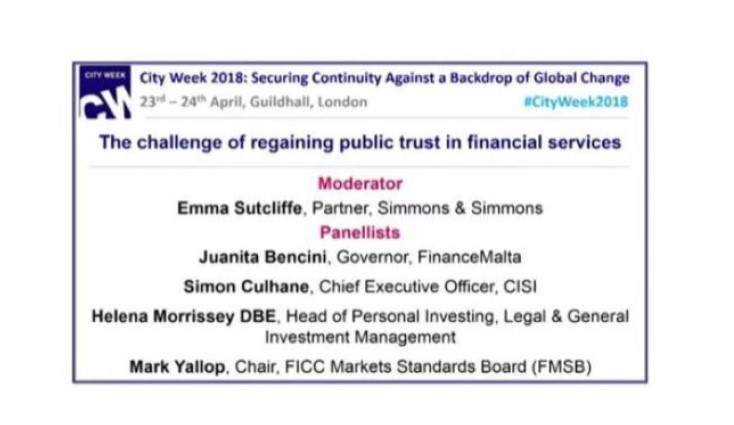
24 April 2018 – FMSB Chair, Mark Yallop participates in The Challenge of Regaining Public Trust in Financial Services panel at the City Week 2018: Securing Continuity Against a Backdrop of Global Change event.
FMSB Releases Draft Standard for Compensating Trade Errors
The National Law Review article
London, 20 March 2018 – The FICC Markets Standards Board (“FMSB”) today publishes its Transparency Draft Standard on Secondary Market Trading Error Compensation.
The Standard deals with the issues concerning how compensation should be paid following a trading error. It sets out that compensation can be paid in the following ways:
• By direct payment to the compensated party’s account
• By reducing or increasing net brokerage
• By another means which does not create a false market in, or a misleading impression as to the value or liquidity of a financial instrument
The Standard makes clear that methods of compensation such as wash trades should not be used (a wash trade is one where a purchase and sale of the same financial instrument occurs with different financial terms in order to pay compensation). These transactions can create a misleading impression regarding volume or price in the market and should be avoided.
It also details that firms should have policies and procedures in place for compensation payments.
FMSB members and other interested parties are invited to comment on the proposed Standard before it is finalised by the FMSB. This consultation will run until 20 June 2018 with the final Standard expected to be published shortly thereafter.
This is the fifth Standard to have been published by the FMSB since it was set up in 2015 in response to the Fair and Effective Markets Review in the UK with a mandate to issue Standards designed to improve conduct and raise standards in the wholesale Fixed Income, Commodity and Currency markets.
All Standards and materials published by FMSB are available at www.fmsb.com.
Media contacts
Maitland
Andy Donald / Joanna Davidson
+44 207 379 5151
adonald@maitland.co.uk
jdavidson@maitland.co.uk
Notes to Editors
1) The Fixed Income, Currency and Commodities (“FICC”) Markets Standards Board
(“FMSB”) is an independent body set up by market practitioners to improve standards of
conduct in wholesale FICC markets. It aims to bring transparency to grey areas in the
wholesale FICC markets by identifying emerging vulnerabilities, clarifying and documenting
practice and agreeing standards to improve conduct and market behaviour. Ensuring that
wholesale FICC markets are transparent, fair and effective is at the heart of the FMSB’s
mission.
2) Setting up the FMSB was one of the main recommendations to emerge from the Fair and
Effective Markets Review (“FEMR”), which was conducted by HM Treasury, the Bank of
England and the Financial Conduct Authority.
3) The FMSB has a Board drawn from senior executives from across wholesale markets,
from corporate clients, asset managers, sell side participants and intermediaries and
infrastructure providers such as exchanges and custodians. Reporting to the Standards
Board are standing sub-committees addressing Market Practices, Codes & Standards
Convergence and Conduct & Ethics. The Market Practices sub-committees are split into 4
asset-class specific committees. There is also an Advisory Council representing the
interests of member firms.
4) The FMSB’s members bring together sell-side investment banks, buyside asset
managers, market infrastructure providers and exchanges, custodians and users of the
market such as corporates. This constitution is unique. The members firms are:
• Allianz Global Investors
• ANZ
• Bank of America Merrill Lynch
• Bank of New York Mellon
• Barclays
• BHP
• BlackRock
• Bloomberg
• BNP Paribas
• BP
• Citadel Securities
• Citigroup Global Markets Limited
• Crédit Agricole CIB
• Credit Suisse
• Deutsche Bank
• Goldman Sachs
• HSBC
• J.P. Morgan
• Legal & General Investment Management
• Linklaters (Legal Advisor)
• Lloyds Banking Group
• London Stock Exchange Group
• M&G Investments
• MarketAxess
• Morgan Stanley
• National Australia Bank
• NEX
• Nomura
• RBS
• Rio Tinto
• Royal Bank of Canada
• Royal Dutch Shell
• Royal Mail Group
• Société Générale
• Standard Chartered
• Standard Life Aberdeen
• State Street
• Thomson Reuters
• TP ICAP
• Tradeweb
• UBS
• Vodafone
• XTX Markets
Download this press release here: Press Release – Secondary Market Trading Error Compensation Standard Transparency Draft
Read the Secondary Market Trading Error Compensation Standard Transparency Draft here: Secondary Market Trading Error Compensation Transparency Draft
How the reporting of Napoleon’s death could help to stop the rot
The Times article by Philip Aldrick
Mark Yallop, FMSB Chair, delivered the opening remarks at the FMSB – Two Years on From The Fair and Effective Markets Review event on 29 November 2017. A full transcript of his speech is available here.
London, 29 November 2017 –
The FICC Markets Standards Board (“FMSB”) is delighted to announce it is hosting an event today which will be addressed by Mark Carney, Governor of the Bank of England, and Andrew Bailey, Chief Executive Officer of the FCA.
FMSB was formed two years ago following the recommendations of the Fair and Effective Markets Review, led by the Bank of England, the FCA and HM Treasury to enhance standards of behaviour in FICC markets.
Addressing conduct issues and re-establishing trust in wholesale markets is a critical mission for banks, investors, corporations, and other market participants, and FMSB is one of the most important initiatives globally in this space.
FMSB develops and publishes Standards and Statements of Good Practice, which are designed to fill the gap between high-level principles and detailed regulation. FMSB is also tasked with identifying emerging vulnerabilities which result from changes and developments in market structures and functions.
Over 200 senior market practitioners from 49 firms and organisations are engaged in the production of FMSB Standards and Statements of Good Practice. FMSB Members include international users of FICC markets such as corporate issuers, asset managers, exchanges, custodians, intermediaries and investment banks, genuinely reflecting the diversity of FICC market participants.
At the event attendees will hear from Mark Carney and Andrew Bailey as well as panel discussions by FMSB members and global industry leaders.
Mark Yallop, Chair of FMSB, said: “FMSB has made significant progress since we were formed and we are delighted to be hosting this event. We have expanded our membership, which now numbers 49 institutions and covers all sections of global FICC market, and published a number of Standards which will help raise standards of behaviour in FICC markets. I’m delighted to welcome Mark Carney and Andrew Bailey to our event and would like thank both UK and overseas regulators for engaging with FMSB so constructively on our work over the last two years.”
ENDS
Enquiries
Maitland
Andy Donald / Joanna Davidson
T: +44 (0) 20 7379 5151
adonald@maitland.co.uk / jdavidson@maitland.co.uk
Notes to Editors:
1) The Fixed Income, Currency and Commodities (“FICC”) Markets Standards Board (“FMSB”) is an independent body set up by market practitioners to improve standards of conduct in wholesale FICC markets. It aims to bring transparency to grey areas in the wholesale FICC markets by identifying emerging vulnerabilities, clarifying and documenting practice and agreeing standards to improve conduct and market behaviour. Ensuring that wholesale FICC markets are transparent, fair and effective is at the heart of FMSB’s mission.
2) Setting up the FMSB was one of the main recommendations to emerge from the Fair and Effective Markets Review (“FEMR”), which was conducted by HM Treasury, the Bank of England and the Financial Conduct Authority.
3) FMSB has a Board drawn from senior executives from across wholesale markets, from corporate clients, asset managers, sell side participants and intermediaries and infrastructure providers such as exchanges and custodians. Reporting to the Standards Board are standing sub-committees addressing Market Practices, Codes & Standards Convergence and Conduct & Ethics. The Market Practices sub-committees are split into 4 asset-class specific committees. There is also an Advisory Council representing the interests of member firms. A full list of individuals can be found below.
4) FMSB’s members bring together sell-side investment banks, buyside asset managers, market infrastructure providers and exchanges, custodians and users of the market such as corporates. This constitution is unique. The members are:
Member Firms:
Allianz Global Investors
ANZ
Bank of America Merrill Lynch
Barclays
BlackRock
Bloomberg
BHP
BNP Paribas
BNY Mellon
BP
Citadel Securities
Citigroup Global Markets Limited
Crédit Agricole CIB
Credit Suisse
Deutsche Bank
Deutsche Börse
Goldman Sachs
HSBC
JP Morgan
Legal & General Investment Management
Linklaters (Legal Advisor)
Lloyds Banking Group
LSE Group
MarketAxess
M&G Investments
Morgan Stanley
National Australia Bank
NEX
Nomura
RBS
Rio Tinto
Royal Bank of Canada
Royal Dutch Shell
Royal Mail Group
Société Générale
Standard Chartered
Standard Life Aberdeen
State Street
Thomson Reuters
TP ICAP
Tradeweb
UBS
Vodafone
XTX Markets
Associate Member Firms:
Association of Corporate Treasurers
Banking Standards Board
KPMG
Oliver Wyman
Standards Board for Alternative Investments
Advisory Council Representatives:
Allianz Global Investors – Elizabeth Corley
Bank of America Merrill Lynch – Alex Wilmot-Sitwell
Barclays – Venkat Venkatakrishnan
BHP – Vandita Pant
BlackRock – Patrick Olson
Bloomberg – Rob Friend
BNP Paribas – Pascal Fischer
BNY Mellon – Michael Cole-Fontayn
BP – Alan Haywood
Citadel Securities – Paul Hamill
Citigroup Global Markets Limited – James Bardrick
Crédit Agricole CIB – Thomas Spitz
Credit Suisse – Eraj Shirvani
Deutsche Bank – Ram Nayak
Deutsche Boerse – Carsten Kengeter
Goldman Sachs – Isabelle Ealet
HSBC – Samir Assaf
Independent – Mary Miller
Independent – Charles Nichols
Independent – Stephen O’Connor
JP Morgan – Daniel Pinto
Legal & General Investment Management – Mark Zinkula
Linklaters – Robert Elliott
Lloyds Banking Group – James Garvey
LSE Group – Raffaele Jerusalmi
M&G Investments – Simon Pilcher
MarketAxess – Rick McVey
Morgan Stanley – Rob Rooney
National Australia Bank – Drew Bradford
NEX – Michael Spencer
Nomura – Jonathan Lewis
RBS – Kieran Higgins
Rio Tinto – Jonathan Slade
Royal Bank of Canada – David Thomas
Royal Dutch Shell – Russell O’Brien
Société Générale – Bruno Benoit
Standard Chartered – Neh Thaker
Standard Life Aberdeen – Brad Crombie
Standard Life Aberdeen – Keith Skeoch
State Street – Kim Newell Chebator
Thomson Reuters – Neill Penney
TP ICAP – David Casterton
Tradeweb – Steve Hall
UBS – David Soanes
Vodafone – Nick Read
XTX Markets – Zar Amrolia
Association of Corporate Treasurers – Caroline Stockmann
Banking Standards Board – Dame Colette Bowe
KPMG – Bill Michael
Oliver Wyman – Christian Edelmann
Standards Board for Alternative Investments – Dame Amelia Fawcett
Standards Board Representatives:
Allianz Global Investors – Elizabeth Corley
Bank of America Merrill Lynch – Graham Hill
Barclays – Nat Tyce
BHP – Vandita Pant
BlackRock – Tarek Mahmoud
BNP Paribas – Ludovic de Montille
BNY Mellon – Dan Watkins
Citadel Securities – Brian Oliver
Citigroup Global Markets Limited – Andy Morton
Deutsche Bank – David Wayne
GFMA – James Kemp
Goldman Sachs – Jim Esposito
HSBC – Thibaut de Roux
Independent – Marc Bailey
Independent – Catherine Bradley
Independent – Charles Nichols
Independent – David Tait
JP Morgan – Guy America
JP Morgan – Sally Dewar
Legal & General Investment Management – Colin Reedie
Linklaters – Michael Kent
LSE Group – Fabrizio Testa
M&G Investments – Simon Pilcher
MarketAxess – Christophe Roupie
Morgan Stanley – Jakob Horder
National Australia Bank – Anthony Deagan
NEX – Stuart Wexler
Nomura – Steven Ashley
Royal Bank of Canada – Sian Hurrell
Royal Dutch Shell – Russell O’Brien
Standard Life Aberdeen – Rod Paris
State Street – Stephen Yeats
Thomson Reuters – Nick Collier
Tradeweb – Enrico Bruni
UBS – Chris Purves
Vodafone – Neil Garrod
XTX Markets – Zar Amrolia
Association of Corporate Treasurers – Caroline Stockmann
Banking Standards Board – Alison Cottrell
KPMG – Karim Haji
Oliver Wyman – Serge Gwynne
Standards Board for Alternative Investments – Thomas Deinet
European Commission calls for high-yield allocation transparency
Reuters article by Yoruk Bahceli
FMSB Chair Mark Yallop spoke at the European Financial Forum at Cumberland Lodge on Thursday 9 November 2017. A full transcript of his speech is available here.
Conduct body targets new issue hedging
Global Capital article by Owen Sanderson
London, 25 October 2017 – The FICC Markets Standards Board (“FMSB”) today publishes its Transparency Draft of the Risk Management Transactions for New Issuance Standard for the Fixed Income markets. The Standard sets out several core principles relevant to risk management transactions associated with new issues in the fixed income markets, and identifies potential conduct risks created by these transactions.
Risk management transactions by an investor or issuer to adjust the cash flow of a new issue to suit their requirements are an important part of the new issue process. The Standard explains why investors and issuers may wish to enter into risk management transactions, the typical types of risk management transactions used, and the conduct risks that are created by their use; in particular, the possibility of influencing the reference rate used in the associated new issue.
The Standard details expected best practice and conduct with respect to
• potential conflicts of interest concerning the selection of the reference rate for a new issue
• the formation of the reference rate and reoffer yield for a new issue
• the hedging of risk acquired by dealers who enter into risk management transactions with investors and issuers
• the dissemination of information about risk management transactions associated with new issues
This Standard applies to activity in the wholesale primary bond markets in Europe but it is anticipated that it will be adopted by participants in primary markets in other jurisdictions over time.
Mark Yallop, Chairman of the FMSB, said:
“This new Standard builds on our already published Standard for New Issues in the European markets and addresses conduct in relation to the hedging and risk management aspects of the New Issue process. It provides further practical, granular assistance to all parties as to how the process should work and is another step in our overall goal to create market practice standards for the whole FICC market.”
FMSB members and other interested parties are invited to comment on the proposed Standard before it is finalised by the FMSB. This consultation will run until Wednesday 20 December 2017 with the final Standard expected to be published early in 2018.
The FMSB anticipates it will undertake further work in the related areas going forward.
This is the fourth Standard to have been published by the FMSB since it was set up in 2015 in response to the Fair and Effective Markets Review in the UK. The Standards are designed to improve conduct and raise standards in the wholesale Fixed Income, Commodity and Currency markets. The FMSB has so far published Standards on Reference Price Transactions, Binary Options in the Commodities markets and on the New Issue Process for Fixed Income Bonds in Europe, all of which are available at www.fmsb.com.
Media contacts
Andy Donald, Maitland +44 207 379 5151
Notes to Editors (more…)
Remarks by Mark Yallop, Chair of FICC Markets Standards Board
London – Wednesday, 4th October 2017
A full transcript of his speech “Rebuilding Trust in Financial Markets” AS DELIVERED.
FMSB Chair Mark Yallop spoke at the Fixed Income Leaders Summit APAC in Singapore on Thursday 28 September 2017. A full transcript of his speech “How can buy and sell side collaboration be brought forward to promote standards in Wholesale Markets?” is available here.
FMSB warns of Ficc market vulnerabilities
FX Markets article by Alessandro Aimone
Real strides are being made in helping banks to do the right thing
Evening Standard article by Anthony Hilton
Bond market standard setter identifies 73 risks
Financial News Article by Vivek Ahuja
20 September 2017
The FICC Markets Standard Board (FMSB) has today issued its 2017 Annual Report setting out the progress it has made to enhance standards of behaviour in the wholesale Fixed Income, Currencies and Commodities (“FICC”) markets.
FMSB was established in 2015 following the recommendations of the Fair and Effective Markets Review which was conducted by the Bank of England, HM Treasury and the Financial Conduct Authority.
FMSB has achieved significant momentum and has received strong support from market participants and public authorities. FMSB membership now represents all sectors and users of global FICC markets and accounts for over 80% of sell side wholesale FICC market activity.
Mark Yallop, Chairman of FMSB said: “In the past 12 months we have made significant progress in our central aim: to raise standards of conduct in the wholesale financial markets and improve outcomes for market participants by making them more transparent, fair and effective. Everything we have seen and done so far has strengthened our conviction about the need for FMSB and the critical role that it has been created to perform.”
This is the first time that such a broad-based, private-sector approach has been undertaken whereby users of the market such as pension funds, corporations, insurance funds and asset managers work together with banks, trading venues and market makers to develop Standards and Statements of Good Practice.
Among the supporters of this initiative, Mark Carney, Governor of the Bank of England, commented in the Annual Report: “Codes and Standards developed by the market for the market lie at the heart of efforts to build efficient, resilient, robust markets and to improve governance and firm culture. Markets are a powerful force for the common good and that is why the FICC Markets Standards Board’s work to establish readily understood, widely followed Standards for global wholesale markets is so important.”
The FMSB Annual Report sets out the benefits of adopting this new approach of creating Standards which will balance the different interests of market users and market makers, and help to restore market discipline and public trust in financial markets.
Andrew Bailey, Chief Executive Officer of the Financial Conduct Authority said: “Good culture and trust go hand in hand. And trust is fundamentally about the honesty and veracity of commitments and the reliability of future promises to your customers, investors, creditors and the public authorities. By codifying agreed Standards that set out these commitments and are accepted by all its Members, FMSB is building an essential foundation for re-establishing public trust in markets again. I am a strong supporter of their work and am very pleased to see the progress made in 2016/17.”
In the period of this Annual Report, FMSB has published three Standards and two Statements of Good Practice. All Member firms at 31 July 2017 have provided Statements of Commitment in relation to Standards finalised in 2016.
Since the date of the Annual Report, two additional Statements of Good Practice have been published. FMSB anticipates publishing several further Standards and Statements of Good Practice in 2017, building upon the body of guidance to which Member firms commit.
The full document is available to view here 31TUhttps://fmsb.com/our-publications/#1U31T
ENDS
Enquiries
Maitland
Andy Donald / Rebecca Mitchell
T: +44 (0) 20 7379 5151
adonald@maitland.co.uk / 31Trmitchell@maitland.co.uk31T
Notes to Editors:
1) The FICC Markets Standards Board (“FMSB”) is an independent body set up by market practitioners to improve standards of conduct in wholesale FICC markets. It aims to bring transparency to grey areas in the wholesale FICC markets by documenting existing practice and agreeing Standards to improve conduct and market behaviour. Ensuring that wholesale FICC markets are transparent, fair and effective is at the heart of the FMSB’s mission.
2) Setting up FMSB was one of the main recommendations to emerge from the Fair and Effective Markets Review (“FEMR”), which was conducted by HM Treasury, the Bank of England and the Financial Conduct Authority and reported in June 2015. The FEMR was launched in June 2014 to reinforce confidence in wholesale Fixed Income, Currency and Commodities markets in the wake of the serious misconduct seen in recent years.
3) FMSB has a high-level Standards Board drawn from senior executives from across wholesale markets, from corporate clients, other market users such as asset managers and asset owners, and infrastructure providers such as exchanges and custodians. Reporting to the Standards Board are standing sub-committees addressing Market Practices, Codes & Standards Convergence and Conduct & Ethics. The Market Practices sub-committees are split into 4 asset-class specific committees. There is also an Advisory Council representing the interests of member firms. A full list of individuals can be found in 5) and 6) below
4) FMSB’s 44 members and 5 associate members bring together sell-side investment banks, buy-side asset managers, exchanges, custodians and users of the market such as corporates.
FMSB’s 44 members are: Aberdeen Asset Management, Allianz Global Investors, Bank of America Merrill Lynch, Barclays, BlackRock, Bloomberg, BHP Billiton, BNP Paribas, BNY Mellon, BP, Citadel Securities, Citigroup Global Markets Limited, Crédit Agricole CIB, Credit Suisse, Deutsche Bank, Deutsche Börse, Goldman Sachs, HSBC, JP Morgan, L&G Investment Management, Linklaters (Legal Advisor), Lloyds Banking Group, LSE Group, M&G Investments, Morgan Stanley, National Australia Bank, NEX, Nomura, PGGM, RBS, Rio Tinto, Royal Bank of Canada, Royal Dutch Shell, Royal Mail Group, Société Générale, Standard Chartered , Standard Life Investments, State Street, Thomson Reuters, TP ICAP, Tradeweb, UBS, Vodafone and XTX Markets.
FMSB also has five Associate Members: the Association of Corporate Treasurers, the Banking Standards Board, the Standards Board for Alternative Investments, KPMG and Oliver Wyman
The FICC Markets Standard Board (FMSB) has today issued two new sets of Statements of Good Practice as part of its work to improve standards in the wholesale Fixed Income, Commodity and Currency (“FICC”) markets.
These documents identify good practice that firms should consider in the areas of front office supervision and the monitoring of written electronic communications.
Mark Yallop, Chair of the FMSB, said: “These latest Statements of Good Practice cover two important areas which support the FMSB strategic objective to enhance standards of behaviour in markets: supervising firms’ front office activities and monitoring written electronic communications. Implementation of effective front office supervisory frameworks promotes the integrity and effectiveness of financial markets leading to better outcomes for all market participants. Given the increasing use of technology, electronic communications need to be adequately monitored as part of efforts to prevent and detect real or potential inappropriate behaviours.”
Front Office Supervision
Supervision in the front office is a fundamental first line of defence for firms when mitigating risks directly related to employee conduct and their business activities in the FICC markets. Front office supervision is key to strengthening a firm’s overall control framework in mitigating both financial and non-financial risks and promoting good employee conduct and culture. There are increasingly high expectations on firms to identify and correct poor conduct before it leads to potentially significant losses or negative impact on the effectiveness and efficiency of markets.
This statement of good practice covers areas including the clear definition of business activities requiring supervision, arrangements for delegation and the experience and competence of supervisors. Good practice is also identified for how firms can operate a defined control framework to demonstrate the maintenance of complete supervisory coverage of all relevant employees and activities over time. This requires clarity of supervisory hierarchies, in particular where global processes or remote locations are subject to supervision.
Electronic Communications
Market practices for the monitoring of written electronic communications continue to evolve. Wholesale market participants are required to implement and maintain controls to aid in the detection of misconduct which may include real or attempted incidents of market abuse and manipulation, bribery, fraud and other inappropriate behaviours.
The FMSB has published a total of 10 good practice statements, which cover areas including: that Firms should ensure that roles and responsibilities for monitoring of written electronic communications are clearly defined across the lines of defence; that Firms should have in place appropriate lexicons and related analytics which reflect the inappropriate behaviour and risks in firm activities that the firm is attempting to prevent and/or detect; that all relevant parties in an organisation, regardless of seniority, are in scope of the surveillance programme; and that alerts generated from surveillance activity are appropriately processed by a firm.
The FMSB was established in 2015 in response to the Fair and Effective Markets Review in the UK with a mandate to improve conduct and raise standards in the wholesale Fixed Income, Commodity and Currency (“FICC”) markets.
As well as the FMSB’s 49 member firms, the Statements of Good Practice will be shared with Non-Member firms and industry trade associations, who are encouraged to consider them.
All the materials are available at www.fmsb.com
ENDS
Enquiries
Maitland
Andy Donald / Rebecca Mitchell
T: +44 (0) 20 7379 5151
adonald@maitland.co.uk / rmitchell@maitland.co.uk
Notes to Editors:
1) The Fixed Income, Currency and Commodities or FICC Markets Standards Board (“FMSB”) is an independent body set up by market practitioners to improve standards of conduct in wholesale FICC markets. It aims to bring transparency to grey areas in the wholesale FICC markets by documenting existing practice and agreeing standards to improve conduct and market behaviour. Ensuring that wholesale FICC markets are transparent, fair and effective is at the heart of the FMSB’s mission.
2) Setting up the FMSB was one of the main recommendations to emerge from the Fair and Effective Markets Review (“FEMR”), which was conducted by HM Treasury, the Bank of England and the Financial Conduct Authority and reported in June 2015. The FEMR was launched in June 2014 to reinforce confidence in wholesale Fixed Income, Currency and Commodities markets in the wake of the serious misconduct seen in recent years.
3) The FMSB has a high-level Standards Board drawn from senior executives from across wholesale markets, from corporate clients, other market users such as asset managers and asset owners, and infrastructure providers such as exchanges and custodians. Reporting to the Standards Board are standing sub-committees addressing Market Practices, Codes & Standards Convergence and Conduct & Ethics. The Market Practices sub-committees are split into 4 asset-class specific committees. There is also an Advisory Council representing the interests of member firms. A full list of individuals can be found in 5) and 6) below
4) The FMSB’s 44 members and 5 associate members bring together sell-side investment banks, buy-side asset managers, exchanges, custodians and users of the market such as corporates.
Please see page 9, where FMSB is referenced under “other initiatives”
Progress report to G20 Leaders – by FSB, 4 July 2017
Remarks made by Mark Yallop, Chair of FICC Markets Standards Board on Thursday 22nd June 2017 at KPMG, 20 Grosvenor Street, London W1K 4QJ. A full transcript of the speech is available here.
London, 25 May 2017. The FICC Markets Standards Board (FMSB) welcomes the new BIS Global FX Code launched today. The Code is an important step forward in improving practice standards in wholesale FX markets.
Mark Yallop, Chair of FMSB said:
“Conduct in the foreign exchange markets was one of the areas of concern highlighted by the U.K. Government’s Fair and Effective Markets Review, which led to the establishment of the FMSB.
“FMSB contributed its prior work on foreign exchange to the BIS FX Working Group in 2015 and we believe that the new BIS Code will make a significant contribution to strengthening standards in the international forex markets.
“It will also complement the work we are undertaking on practice standards in other areas of the wholesale FICC Markets.”
–Ends–
For further information please contact:
Mark Yallop
Chair, FMSB
T: +44 (0) 203 861 6431
M: +44 (0) 7785 901 467
mark.yallop@fmsb.com
Gerry Harvey
CEO, FMSB
T: +44 (0) 203 861 6432
M: +44 (0) 7718 883 128
gerry.harvey@fmsb.com
Peter Wilson-Smith
Meritus Consultants
T: +44 (0)20 7043 4604
M: +44 (0)7979 526152
pws@meritusconsultants.com
Notes to Editors:
1) The Fixed Income, Currency and Commodities or FICC Markets Standards Board
(“FMSB”) is an independent body set up by market practitioners to improve
standards of conduct in wholesale FICC markets. It aims to bring transparency to
grey areas in the wholesale FICC markets by documenting existing practice and
agreeing standards to improve conduct and market behaviour. Ensuring that
wholesale FICC markets are transparent, fair and effective is at the heart of the
FMSB’s mission.
2) Setting up the FMSB was one of the main recommendations to emerge from the
Fair and Effective Markets Review (“FEMR”), which was conducted by HM
Treasury, the Bank of England and the Financial Conduct Authority and reported in
June 2015. The FEMR was launched in June 2014 to reinforce confidence in
wholesale Fixed Income, Currency and Commodities markets in the wake of the
serious misconduct seen in recent years.
3) The FMSB has a high-level Standards Board drawn from senior executives from
across wholesale markets, from corporate clients, other market users such as asset
managers and asset owners, and infrastructure providers such as exchanges and
custodians. Reporting to the Standards Board are standing sub-committees
addressing Market Practices, Codes & Standards Convergence and Conduct &
Ethics. The Market Practices sub-committees are split into 4 asset-class specific
committees. There is also an Advisory Council representing the interests of member
firms. A full list of individuals can be found in 5) and 6) below
4) The FMSB’s 44 members and 6 standing guests bring together sellside
investment banks, buyside asset managers, exchanges, custodians and users of
the market such as corporates. They are:
Member Firms:
Aberdeen Asset Management
Allianz Global Investors
Bank of America Merrill Lynch
Barclays
BlackRock
Bloomberg
BHP Billiton
BNP Paribas
BNY Mellon
BP
Citadel Securities
Citigroup Global Markets Limited
Crédit Agricole CIB
Credit Suisse
Deutsche Bank
Deutsche Börse
Goldman Sachs
HSBC
J.P. Morgan
Legal & General Investment Management
Linklaters (Legal Advisor)
Lloyds Banking Group
London Stock Exchange Group
M&G Investments
National Australia Bank
Morgan Stanley
NEX
Nomura
PGGM
RBS
Rio Tinto
Royal Dutch Shell
Royal Mail Group
Scotiabank
Société Générale
Standard Chartered
Standard Life Investments
State Street
Thomson Reuters
TP ICAP
Tradeweb
UBS
Vodafone
XTX Markets
Standing Guests:
Association of Corporate Treasurers
Banking Standards Board
Global Financial Markets Association (GFMA)
Hedge Fund Standards Board
KPMG
Oliver Wyman
5) Advisory Council representatives:
Member Firm: Representative:
Aberdeen Asset Management Brad Crombie
Allianz Global Investors Elizabeth Corley
Bank of America Merrill Lynch Alex Wilmot-Sitwell
Barclays Venkat Venkatakrishnan
BHP Billiton Vandita Pant
BlackRock Patrick Olson
Bloomberg Rob Friend
BNP Paribas Pascal Fischer
BP Alan Haywood
Citadel Securities Paul Hamill
Citigroup Global Markets Limited James Bardrick
Crédit Agricole CIB Thomas Spitz
Credit Suisse Eraj Shirvani
Deutsche Bank David Wayne
Deutsche Boerse Group Carsten Kengeter
Goldman Sachs Isabelle Ealet
HSBC Douglas Flint
Independent Mary Miller
Independent Charles Nichols
JP Morgan Guy America
JP Morgan Daniel Pinto
Legal & General Investment Management Mark Zinkula
Linklaters (Legal Advisor) Robert Elliott
Lloyds Banking Group James Garvey
London Stock Exchange Group Raffaele Jerusalmi
M&G Investments Simon Pilcher
Morgan Stanley Rob Rooney
National Australia Bank Drew Bradford
NEX Michael Spencer
Nomura Jonathan Lewis
PGGM Patrick Fleur
Royal Bank of Scotland Kieran Higgins
Royal Dutch Shell Russell O’Brien
Royal Mail Matthew Lester Scotiabank Kevin Felix
Société Générale Frank Drouet
Standard Chartered Neh Thaker
Standard Life Investments Keith Skeoch
State Street Kim Newell
Thomson Reuters Neill Penney
TP ICAP David Casterton
Tradeweb Enrico Bruni
UBS David Soanes
Vodafone Nick Read
XTX Markets Zar Amrolia
Standing Guests: Representative:
Association of Corporate Treasurers Caroline Stockmann Banking Standards Board Dame Colette Bowe
Hedge Fund Standards Board Dame Amelia Fawcett
KPMG Bill Michael
Oliver Wyman Christian Edelmann
6) Standards Board representatives:
Standards Board member: Firm:
Elizabeth Corley Allianz Global Investors
Graham Hill Bank of America Merrill Lynch
Nat Tyce Barclays
Vandita Pant BHP Billiton
Tarek Mahmoud BlackRock
Ludovic de Montille BNP Paribas Michael Cole-Fontayn Bank of New York Mellon
Brian Oliver Citadel Securities
Andy Morton Citigroup Global Markets Limited
James Kemp GFMA
Jim Esposito Goldman Sachs
Thibaut de Roux HSBC
Marc Bailey Independent
Catherine Bradley Independent
Charles Nichols Independent
Guy America JP Morgan
Sally Dewar JP Morgan
Anton Eser Legal & General Investment Mgmt
Michael Kent Linklaters (Legal Advisor)
Fabrizio Testa London Stock Exchange Group
Simon Pilcher M&G Investments
Jakob Horder Morgan Stanley
Anthony Deagan National Australia Bank
Steven Ashley Nomura Patrick Fleur PGGM
Russell O’Brien Royal Dutch Shell
John Kirwan Scotiabank Rod Paris Standard Life Investments
Stephen Yeats State Street
Nick Collier Thomson Reuters
Enrico Bruni Tradeweb
Chris Purves UBS Neil Garrod Vodafone
Zar Amrolia XTX Markets
Standing Guests:
Caroline Stockmann Association of Corporate Treasurers
Alison Cottrell Banking Standards Board
Thomas Deinet Hedge Fund Standards Board
Serge Gwynne Oliver Wyman
FMSB Chair Mark Yallop spoke at the Fixed Income Leaders Summit in Boston on May 18 2017. A full transcript of his speech, “Setting FICC Standards: How can buy and sell side collaboration be brought forward to promote standards in Wholesale Markets?” is available here.
The Morning Ledger: Global Deal Making Hits Dry Spell
Rheaa Rao, The Wall Street Journal / CFO Journal
London, 2 May 2017. Leading market participants have published final guidelines that clarify expected behaviour during the new issue process for fixed income bonds in Europe.
A series of measures are detailed in the new standard from the FICC Markets Standards Board (“FMSB”) to enhance the fairness and effectiveness of the new issue process for all participants.
An initial Transparency Draft was published in November last year and the final version of the New Issue Process Standard for the Fixed Income Markets is published today after comment from interested parties. The standard covers a range of topics from the granting of a mandate to the publication of deal statistics.
Mark Yallop, Chair of the FMSB, said: “The new standard is the result of extensive discussions between banks, corporate issuers and investors, both among our membership and from a large number of other important market participants during the Transparency Draft process. It is a significant step in clarifying practices in the market and ensuring it is both fair and effective.”
The main proposals in the standard are that:
• Lead banks should make their allocation policies, or a summary, available to issuers and all market participants.
• The issuer’s preferences should be taken in account when deciding the allocation policy for a specific/individual deal.
• When a mandate is granted, the lead banks and issuer should discuss, understand and agree the issuer’s objectives for the transaction and how the banks will achieve them, including such considerations as allocation preferences and marketing strategy for the deal.
• Lead banks should disclose publicly to all market participants their general policy, or a summary, for how they select investors for market soundings and roadshows. The policy for a specific deal should take account of any issuer preferences.
• Lead banks should agree a strategy on book disclosure frequency with the issuer. Book updates should be disclosed publicly and should not be misleading.
• Investors need time to collate their demand for a transaction. It is best practice to make no significant changes to indicative issue terms, or to publicise the order book size, during the last 15 minutes of the bookbuild.
• Investors should only submit clear orders which are a true reflection of their demand.
Jonathan Brown, Head of Investment Grade Syndicate, EMEAPAC, Barclays said:
“This standard builds on continuous work from FMSB member firms and other industry bodies to ensure that as the fixed income new issue market evolves it remains fit for purpose. The paper goes beyond recent and upcoming regulation and will lead to a more open and transparent process thanks to input from issuers, investors and lead manager banks.”
FMSB members include leading corporate issuers such as BHP Billiton, BP, Vodafone, Rio Tinto, Royal Mail Group and Royal Dutch Shell, major investors such as M&G and Blackrock, and many of the senior global fixed income dealers.
The new standard is intended to apply in respect of all best efforts syndicated offerings of fixed income bonds in the European wholesale markets, including investment grade, high yield, securitised and emerging market debt. The expectation is that in time the standard will be adopted by primary markets participants in other jurisdictions.
The standard is the third to be completed by the FMSB, following earlier standards on Reference Price Transactions and Binary Options in the commodities markets.
Future standards will focus on the secondary market aspects of new bond issuance such as hedging activity, the appropriate process covering the dissemination of information and market colour in commodities and other wholesale markets, and conduct issues that relate to the use of trading technology in financial markets.
Final versions of the FMSB standards on Reference Price Transactions and Binary Options in the commodities markets are available on the FMSB website at www.fmsb.com.
– ENDS –
Media enquiries:
Meritus Consultants
Peter Wilson-Smith +44 (0)20 7043 4604 or +44 (0)7979 526152
pws@meritusconsultants.com
Sehr Sarwar +44 (0)20 7043 4606 or +44 (0)7966 963 669
ssarwar@meritusconsultants.com
FMSB Chair Mark Yallop spoke at the FT Banking Standard Conference in London on 27 April 2017. A full transcript of his speech, “Rebuilding Trustworthiness in Financial Markets”, is available here.
Danielle Myles speaks with Mark Yallop, Chair of the FICC Markets Standards Board about why regulation alone can’t govern market behaviour and misconduct’s cost to the banking industry.
Danielle Myles is The Banker’s Investment Banking and Capital Markets Editor.
(Duration: 8m 08s)
Bank of England’s Shafik signs off with defence of experts
Lucy McNulty, Financial News
Mark Yallop addressed the Political Economy of Financial Markets (PEFM) Seminar on February 13, 2017. A full transcript of his speech, “Rebuilding Trustworthiness in Financial Markets” is available here.
City shake-up could see off European rivals
Anthony Hilton, Evening Standard
London, 8 December 2016. Using automated voice surveillance systems and surveillance techniques involving Natural Language Processing are among the emerging practices being used to combat the risk of insider dealing and market manipulation, according to new guidelines from the FICC Markets Standards Board (“FMSB”).
The practices are highlighted in a new FMSB paper or ‘Statement of Good Practice’ on surveillance, which sets out the Core Principles that firms should consider and also identifies current good practice for surveillance in the foreign exchange markets.
In a separate Statement of Good Practice on conduct training in wholesale fixed income markets, the FMSB recommends that senior front office managers should play a bigger role in conduct training, making time for face-to-face discussion of conduct issues with staff.
Mark Yallop, Chair of the FMSB, said:
“More effective surveillance systems and better conduct training are two areas the industry needs to work on to improve conduct in wholesale fixed income markets. These statements of good practice share good or best practice in the industry but more importantly, they allow firms to measure themselves against their peers.”
Among the Core Principles for surveillance practice that the FMSB recommends firms consider are: ensuring the surveillance function is independent of the front office; that there is effective governance and controls; and that surveillance systems are reviewed regularly to make sure they are fit for purpose as risks change.
Mark Yallop added:
“Firms need to keep their surveillance practices constantly under review. This is a fast-developing area and technology is having a profound impact on industry practice”.
The need for better surveillance to address market manipulation was identified by the Fair and Effective Markets Review (FEMR) which said in June 2015 that “substantial further development of firms’ misconduct surveillance is required to deliver fully effective oversight of FICC markets.”
Another area highlighted by the FEMR was training. The focus of the FMSB Statement of Good Practice is on conduct training rather than technical competence and key elements identified by the FMSB are: the need for clear structures and lines of responsibility for delivering training; training tailored to individuals’ role and experience; and more face-to-face training from senior front line managers who understand the business best.
The FMSB also highlights the use of gaming technology for exploring real-life or grey areas and suggests firms keep this emerging area under review.
The new FMSB guidance on surveillance and training is contained in:
The FMSB’s Statements of Good Practice differ from FMSB standards, which all members are expected to comply with. They highlight current good practice and member firms are expected to consider them and amend their own practices if appropriate. As well as the FMSB’s 41 member firms, the Statements of Good Practice will be shared with Non-Member firms and industry trade associations, who are encouraged to consider them.
Last month, the FMSB published a draft standard on the New Issue Process for the Fixed Income Markets, in draft transparency form for comment, following earlier standards on Reference Price Transactions and Binary Options in the commodities markets. These can be viewed at fmsb.com/standards/
– ENDS –
Media enquiries:
Meritus Consultants
Peter Wilson-Smith
+44 (0)20 7043 4604 or +44 (0)7979 526152
pws@meritusconsultants.com
Sehr Sarwar
+44 (0)20 7043 4606 or +44 (0)7966 963 669
ssarwar@meritusconsultants.com
Notes to Editors:
1) The Fixed Income, Currency and Commodities or FICC Markets Standards Board (“FMSB”) is an independent body set up by market practitioners to improve standards of conduct in wholesale FICC markets. It aims to bring transparency to grey areas in the wholesale FICC markets by documenting existing practice and agreeing standards to improve conduct and market behaviour. Ensuring that wholesale FICC markets are transparent, fair and effective is at the heart of the FMSB’s mission.
2) Setting up the FMSB was one of the main recommendations to emerge from the Fair and Effective Markets Review (“FEMR”), which was conducted by HM Treasury, the Bank of England and the Financial Conduct Authority and reported in June 2015. The FEMR was launched in June 2014 to reinforce confidence in wholesale Fixed Income, Currency and Commodities markets in the wake of the serious misconduct seen in recent years.
3) The FMSB has a Standards Board drawn from senior executives from across wholesale markets, from corporate clients, other market users such as asset managers and asset owners, and infrastructure providers such as exchanges and custodians. There is also an Advisory Council representing the interests of member firms.
4) The FMSB’s 41 members and 5 standing guests bring together sellside investment banks, buyside asset managers, exchanges, custodians and users of the market such as corporates. They are:
Member Firms:
Aberdeen Asset Management; Allianz Global Investors; Bank of America Merrill Lynch; Bank of New York Mellon; Barclays; BlackRock; Bloomberg; BNP Paribas; BP; Citi; CQS; Crédit Agricole CIB; Credit Suisse; Deutsche Bank; Deutsche Börse Group; Goldman Sachs; HSBC; ICAP; J.P. Morgan; Legal & General Investment Management; Linklaters (Legal Advisor); Lloyds Banking Group; London Stock Exchange Group; M&G Investments; Morgan Stanley; Nomura; PGGM; RBS; Rio Tinto; Royal Dutch Shell; Royal Mail Group; Scotiabank; Société Générale; Standard Chartered; Standard Life Investments; State Street; Thomson Reuters; Tradeweb; UBS; Vodafone; XTX Markets.
Standing Guests:
Association of Corporate Treasurers; Banking Standards Board; Hedge Fund Standards Board; KPMG; Oliver Wyman.
A full list of Advisory Council representatives and Standards Board members, can be found here: 16-12 FMSB Member List
New Standards Proposed for Fixed Income Issuance
Shanny Basar, Markets Media
Should the Bond Market Be More Honest? Some on Wall Street Say ‘Yes’
Liz Hoffman, The Wall Street Journal
London, 18 November 2016. Banks should be more transparent about their allocation policies and investors should make sure their orders are a true representation of their demand, according to a proposed new standard on corporate and other debt issues from the FICC Markets Standards Board (“FMSB”).
The New Issue Process Standard for the Fixed Income Markets sets out a range of improvements to the new issue process in the European market, from the granting of a mandate to publication of statistics.
The standard, which is being published as a transparency draft for comment, builds on the ICMA code for investment grade debt but would apply to all widely syndicated offerings of credit products in the wholesale markets, including investment grade, high yield, securitization and emerging market debt.
The standard is the third to be published by the FMSB, following earlier standards on Reference Price Transactions and Binary Options in the commodities markets.
Mark Yallop, Chair of the FMSB, said:
“This standard is the result of a unique joint effort by corporate users of the market, institutional investors and underwriting banks to bring greater clarity to the process for issuing debt and ensure it works fairly and effectively for all concerned. We believe it is a significant step in raising standards.”
Robert Rooney, Chief Executive of Morgan Stanley International and chair of the FMSB’s Fixed Income, Spread Products sub-committee, said:
“These proposals are aimed at the wholesale fixed income markets in Europe but over time we think market pressures will lead to this standard being adopted more broadly internationally. This is what good practice looks like whatever part of the world you are in.”
Russell O’Brien, Group Treasurer, Royal Dutch Shell and FMSB Board Member, said: “Corporates issuing debt in the fixed income markets will welcome having greater clarity and transparency in the process. We would like to see all our syndicate banks and investors adopting this standard.”
The new standard is applicable to all the main participants in the wholesale fixed income markets in the Europe, including issuers, investors and underwriting banks. Although initially the standard will be adopted by FMSB members in respect of issues in the European markets, the expectation is that primary markets participants in other jurisdictions will adopt the standard over time.
The main proposals in the standard are that:
The FMSB is seeking comment from interested parties on the New Issue Process Standard for the Fixed Income Markets over the next two months. Submissions should be sent to standards@fmsb.com by midday (12:00pm GMT), 17 January, 2017. A final version of the standard will be published by the FMSB after evaluating public comments.
Final versions of the FMSB standards on Reference Price Transactions and Binary Options in the commodities markets have now been posted on the FMSB website at https://fmsb.com/standards/ following the period for comment.
– ENDS –
Media enquiries:
Meritus Consultants
Peter Wilson-Smith
+44 (0)20 7043 4604 or +44 (0)7979 526152
pws@meritusconsultants.com
Sehr Sarwar
+44 (0)20 7043 4606 or +44 (0)7966 963 669
ssarwar@meritusconsultants.com
Notes to Editors:
1) The Fixed Income, Currency and Commodities or FICC Markets Standards Board (“FMSB”) is an independent body set up by market practitioners to improve standards of conduct in wholesale FICC markets. It aims to bring transparency to grey areas in the wholesale FICC markets by documenting existing practice and agreeing standards to improve conduct and market behaviour. Ensuring that wholesale FICC markets are transparent, fair and effective is at the heart of the FMSB’s mission.
2) Setting up the FMSB was one of the main recommendations to emerge from the Fair and Effective Markets Review (“FEMR”), which was conducted by HM Treasury, the Bank of England and the Financial Conduct Authority and reported in June 2015. The FEMR was launched in June 2014 to reinforce confidence in wholesale Fixed Income, Currency and Commodities markets in the wake of the serious misconduct seen in recent years.
3) The FMSB has a high-level Standards Board drawn from senior executives from across wholesale markets, from corporate clients, other market users such as asset managers and asset owners, and infrastructure providers such as exchanges and custodians. Reporting to the Standards Board are standing sub-committees addressing Market Practices, Codes & Standards Convergence and Conduct & Ethics. The Market Practices sub-committees are split into 4 asset-class specific committees. There is also an Advisory Council representing the interests of member firms.
4) The FMSB’s 38 members and 5 standing guests bring together sellside investment banks, buyside asset managers, exchanges, custodians and users of the market such as corporates. They are:
Member Firms:
Aberdeen Asset Management; Allianz Global Investors; Bank of America Merrill Lynch; Bank of New York Mellon; Barclays; BlackRock; Bloomberg; BNP Paribas; Citi; CQS; Crédit Agricole CIB; Credit Suisse; Deutsche Bank; Deutsche Börse Group; Goldman Sachs; HSBC; ICAP; J.P. Morgan; Legal & General Investment Management; Linklaters (Legal Advisor); Lloyds Banking Group; London Stock Exchange Group; M&G Investments; Morgan Stanley; Nomura; PGGM; RBS; Royal Dutch Shell; Scotiabank; Société Générale; Standard Chartered; Standard Life Investments; State Street; Thomson Reuters; Tradeweb; Unilever; UBS; Vodafone.
Standing Guests:
Association of Corporate Treasurers; Banking Standards Board; Hedge Fund Standards Board; KPMG; Oliver Wyman.
A full list of Advisory Council representatives and Standards Board members, can be found here: 16-11 FMSB Member List
London, 18 November 2016. The FICC Markets Standards Board (“FMSB”) has today published its third standard aimed at improving conduct in the wholesale Fixed Income, Currency and Commodities (“FICC”) markets.
The standard, which is being published as a transparency draft for comment, builds on the ICMA code for investment grade debt but would apply to all widely syndicated offerings of credit products in the wholesale markets, including investment grade, high yield, securitization and emerging market debt.
The New Issue Process Standard for the Fixed Income Markets sets out a range of improvements to the new issue process in the European market, from the granting of a mandate to publication of statistics.
The FMSB is issuing the standard in draft form to provide an opportunity for public comment ahead of final ratification and issuance.
The FMSB is seeking comment from interested parties on the new standard over the next two months.
Submissions should be sent to standards@fmsb.com by midday (12:00pm GMT), 17 January, 2017.
FMSB Chair Mark Yallop addressed the Fixed Income Leaders (FILS) Conference on November 10, 2016 with the speech “FICC Markets Standards Board: bringing buy-side and sell-side together to promote Standards in Wholesale Markets.” The complete transcript of his speech is available here.
Mark Yallop addressed the Fair and Effective Markets Review (FEMR) Conference on September 29, 2016. A full transcript of his speech, “Regulation, Ethics and Standards in Wholesale Financial Markets”, is available here.
Mark Yallop, FMSB Chair, addressed the International Capital Markets Association (ICMA) European Repo and Collateral Council (ERCC) General Meeting on September 27, 2016. His speech, “Regulation, Ethics and Standards in Wholesale Financial Markets”, is available here.
Gerry Harvey becomes new FMSB chief executive
Mikael Latreille, FX Week
MOVES-FICC standards body names Harvey CEO
Steve Slater, Reuters IFR
London, 5 August 2016. The FICC Markets Standards Board (“FMSB”) has appointed Gerry Harvey as its first Chief Executive Officer. Gerry Harvey has 30 years’ experience in the wholesale financial markets and extensive experience in the regulatory field.
Mark Yallop, Chair of the FICC Market Standards Board (FMSB), said:
“I am delighted Gerry is joining the FMSB. He has a deep knowledge of business practices, market structures and regulation in the fixed income, foreign exchange and commodities markets. We couldn’t have found a better person to lead the FMSB through the next stages of its journey raising standards across wholesale markets.”
Gerry Harvey said:
“The FMSB has a critical role to play in ensuring markets are fair and effective and I am much looking forward to taking up the position of Chief Executive Officer.”
Gerry Harvey was formerly Group Head of Compliance at ICAP plc from 2010 to 2015. He has also worked as Chief Compliance Officer at Gartmore and before that spent five years as Head of Regulatory Risk for Debt Markets at the Royal Bank of Scotland. He is a qualified lawyer and his working career included spells at LIFFE and the London Stock Exchange.
The FMSB recently published its first two standards aimed at improving conduct in the wholesale markets. The standards, which have been issued in draft form for comment, cover binary options in the commodities markets and reference price transactions in the fixed income rates markets.
– ENDS –
Media enquiries:
Meritus Consultants
Peter Wilson-Smith +44 (0)20 7043 4604 or +44 (0)7979 526152
pws@meritusconsultants.com
Sehr Sarwar +44 (0)20 7043 4606 or +44 (0)7966 963 669
ssarwar@meritusconsultants.com
Notes to Editors:
1) Gerry Harvey was Group Head of Compliance at ICAP plc from September 2010 to 2015, where he led a team of 50 staff supporting voice broking, electronic trading and post trade service business units operating across 42 jurisdictions worldwide. Before ICAP, he worked at Gartmore Investment Management Ltd, RBS plc, Nikko Europe Ltd and LIFFE in a variety of senior positions. He is a qualified solicitor and from 2000-2003, he practised financial services law and regulation at Milbank, Tweed, Hadley and McCloy and from 1999-2000 at Cadwallader, Wickersham and Taft. Gerry has an MA in Comparative History from the University of Essex and completed his Graduate Diploma in Law at London Guildhall University in 1999.
2) The Fixed Income, Currency and Commodities or FICC Markets Standards Board (“FMSB”) is an independent body set up by market practitioners in 2015 to improve standards of conduct in wholesale FICC markets. It aims to bring transparency to grey areas in the wholesale FICC markets by documenting existing practice and agreeing standards to improve conduct and market behaviour. Ensuring that wholesale FICC markets are transparent, fair and effective is at the heart of the FMSB’s mission.
3) Setting up the FMSB was one of the main recommendations to emerge from the Fair and Effective Markets Review (“FEMR”), which was conducted by HM Treasury, the Bank of England and the Financial Conduct Authority and reported in June 2015. The FEMR was launched in June 2014 to reinforce confidence in wholesale Fixed Income, Currency and Commodities markets in the wake of the serious misconduct seen in recent years.
4) The FMSB has a high-level Standards Board drawn from senior executives from across wholesale markets, from corporate clients, other market users such as asset managers and asset owners, and infrastructure providers such as exchanges and custodians. Reporting to the Standards Board are three standing sub-committees addressing Market Practices, Codes & Standards Convergence and Conduct & Ethics. The Market Practices sub-committees are split into 4 asset-class specific committees.
There is also an Advisory Council representing the interests of member firms. A full list of individuals can be found in 6) and 7) below
5) The FMSB’s 36 members and 5 standing guests bring together sellside investment banks, buyside asset managers, exchanges, custodians and users of the market such as corporates. They are:
Member Firms:
Aberdeen Asset Management; Allianz Global Investors; Bank of America Merrill Lynch; Bank of New York Mellon; Barclays; BlackRock; Bloomberg; BNP Paribas; Citi; CQS; Crédit Agricole CIB; Credit Suisse; Deutsche Bank; Deutsche Börse Group; Goldman Sachs; HSBC; ICAP; J.P. Morgan; Legal & General Investment Management; Linklaters (Legal Advisor); Lloyds Banking Group; London Stock Exchange Group; M&G Investments; Morgan Stanley; Nomura; PGGM; RBS; Royal Dutch Shell; Scotiabank; Société Générale; Standard Chartered; Standard Life Investments; State Street; Thomson Reuters; Tradeweb; UBS.
Standing Guests:
Association of Corporate Treasurers; Banking Standards Board; Hedge Fund Standards Board; KPMG; Oliver Wyman.
A full list of Advisory Council representatives and Standards Board members, can be found here: 16-07 FMSB Member List
London, 22 July 2016. The FICC Markets Standards Board (“FMSB”) has today published its second standard aimed at improving conduct in the wholesale Fixed Income, Currency and Commodities (“FICC”) markets. The standard, which is being issued in draft form for comment, covers binary options in the commodities markets.
Binary options, also known as barrier or digital options, pay out a fixed amount, or nothing, depending on whether the underlying price of a commodity hits a pre-agreed level at a specific point in time. This creates an inherent conflict between the bank or dealer selling the option and the client.
Elizabeth Corley, Interim Chair of the FMSB, said:
“This has been a priority area for the FMSB because of the recent well-publicised misconduct that binary options have given rise to. The new standard outlines the rationale for use of binary options and also makes clear the guidelines that market participants should follow to ensure they manage the conflict of interest in an appropriate fashion.”
The new standard has been drawn up after extensive consultation among FMSB members and regulatory authorities. It is being issued in the form of a transparency draft to provide an opportunity for public comment ahead of final ratification and issuance. The binary options standard is the second to be published by the FMSB, which was set up a year ago by market practitioners following the Fair and Effective Markets Review (“FEMR”) to improve conduct in the wholesale FICC markets. It does this by defining standards of good practice in contentious or grey areas of the markets.
Last month, the FMSB published a standard on reference price transactions in the fixed income rates markets. These transactions involve agreeing all aspects of a transaction except price which is set later based on a pre-agreed reference price and market. The standard set out guidance for practitioners about what is acceptable conduct in the context of these types of transaction and create greater clarity about what good market practice looks like, and what types of practice should be avoided.
The FMSB has 36 members reflecting the diversity of participants in the wholesale FICC markets. They include international users of the markets such as corporates, asset owners and asset managers, market infrastructure providers such as exchanges, custodians, and investment banks.
The FMSB is seeking comment from interested parties on the binary options standard over the summer. Submissions should be sent to standards@fmsb.com by midday (12:00pm BST), Friday 14th October, 2016. A final version of the standard will be published by the FMSB after evaluating public comments.
– ENDS –
Media enquiries:
Meritus Consultants Peter Wilson-Smith +44 (0)20 7043 4604 or +44 (0)7979 526152 pws@meritusconsultants.com
Sehr Sarwar +44 (0)20 7043 4606 or +44 (0)7966 963 669 ssarwar@meritusconsultants.com
Notes to Editors:
Member Firms:
Aberdeen Asset Management; Allianz Global Investors; Bank of America Merrill Lynch; Bank of New York Mellon; Barclays; BlackRock; Bloomberg; BNP Paribas; Citi; CQS; Crédit Agricole CIB; Credit Suisse; Deutsche Bank; Deutsche Börse Group; Goldman Sachs; HSBC; ICAP; J.P. Morgan; Legal & General Investment Management; Linklaters (Legal Advisor); Lloyds Banking Group; London Stock Exchange Group; M&G Investments; Morgan Stanley; Nomura; PGGM; RBS; Royal Dutch Shell; Scotiabank; Société Générale; Standard Chartered; Standard Life Investments; State Street; Thomson Reuters; Tradeweb; UBS.
Standing Guests:
Association of Corporate Treasurers; Banking Standards Board; Hedge Fund Standards Board; KPMG; Oliver Wyman.
A full list of Advisory Council representatives and Standards Board members, can be found here: 16-07 FMSB Member List
London, 22 July 2016. The FICC Markets Standards Board (“FMSB”) has today published its second standard aimed at improving conduct in the wholesale Fixed Income, Currency and Commodities (“FICC”) markets.
The standard, which is being issued in draft form for comment, covers binary options in the commodities markets.
Binary options, also known as barrier or digital options, pay out a fixed amount, or nothing, depending on whether the underlying price of a commodity hits a pre-agreed level at a specific point in time. This creates an inherent conflict between the bank or dealer selling the option and the client.
The FMSB is issuing the standard in draft form to provide an opportunity for public comment ahead of final ratification and issuance.
The FMSB is seeking comment from interested parties on the new standard over the summer.
Submissions should be sent to standards@fmsb.com by midday (12:00pm GMT), Friday 14th October, 2016.
Draft conduct standard for FICC markets
Claire Cummings, Lexology
Banks warned over conflict of interest
Caroline Binham and Philip Stafford, FT
London, 30 June 2016. The FICC Markets Standards Board (“FMSB”) has today published its letter written by the Chair to the FEMR Principals following the first anniversary of the FMSB. The FMSB was set up by market practitioners following the Fair and Effective Markets Review (“FEMR”) to improve conduct in the wholesale FICC markets. It does this by defining standards of good practice in contentious or grey areas of the markets.
To read the letter, please click here.
– ENDS –
Media enquiries:
Meritus Consultants Peter Wilson-Smith +44 (0)20 7043 4604 or +44 (0)7979 526152 pws@meritusconsultants.com
Sehr Sarwar +44 (0)20 7043 4606 or +44 (0)7966 963 669 ssarwar@meritusconsultants.com
London, 30 June 2016. The FICC Markets Standards Board (“FMSB”) has today published its first standard aimed at improving conduct in the wholesale Fixed Income, Currency and Commodities (“FICC”) markets.
The standard, which is being issued in draft form for comment, covers reference price transactions in the fixed income rates markets.
Fixed Income reference price transactions, involve agreeing all aspects of a transaction except price which is set later based on a pre-agreed reference price.
The FMSB is issuing the standard in draft form to provide an opportunity for public comment ahead of final ratification and issuance.
The FMSB is seeking comment from interested parties on the new standard over the summer.
Submissions should be sent to standards@fmsb.com by midday (12:00pm BST), Thursday 8th September, 2016.
A final version of the standard will be published by the FMSB after evaluating public comments.
– ENDS –
London, 30 June 2016. The FICC Markets Standards Board (“FMSB”) has today published its first standard aimed at improving conduct in the wholesale Fixed Income, Currency and Commodities (“FICC”) markets.
The standard, which is being issued in draft form for comment, covers reference price transactions in the fixed income rates markets. [Click here for standard]
Fixed Income reference price transactions, involve agreeing all aspects of a transaction except price which is set later based on a pre-agreed reference price.
Elizabeth Corley, Interim Chair of the FMSB, said:
“The new standard is intended to give clear guidance to traders and market practitioners about what is acceptable conduct in the context of these types of transaction and create greater clarity about what good market practice looks like, and what types of practice should be avoided.”
The FMSB is issuing the standard in draft form to provide an opportunity for public comment ahead of final ratification and issuance.
Publication of the draft standard coincides with the first anniversary of the FMSB [Click here for letter to FEMR Principals], which was set up by market practitioners following the Fair and Effective Markets Review (“FEMR”) to improve conduct in the wholesale FICC markets. It does this by defining standards of good practice in contentious or grey areas of the markets.
The FMSB Market Practices Sub-Committees are currently working on standards in a range of other areas such as commodity binary options and the new issue process in fixed income markets.
The FMSB’s Conduct & Ethics Sub-Committee is also doing work to assess formal wholesale FICC markets training programmes undertaken by member firms as well as facilitated workshops with surveillance representatives from FMSB member firms, focusing on the trade lifecycle in Foreign Exchange. The intention is to complete papers summarising good practice in both these areas by the year end.
The Codes & Standards Convergence Sub-Committee has met with authorities in a number of other countries to discuss international convergence of standards.
The FMSB has 36 members reflecting the diversity of participants in the wholesale FICC markets. They include international users of the markets such as corporates, asset owners and asset managers, market infrastructure providers such as exchanges, custodians, and investment banks.
Elizabeth Corley said:
“The FMSB has benefited from a strong and continuous level of engagement from members of Standards Board and Advisory Council, drawn from senior practitioners and experienced independents. We look forward to continuing to engage with both members and other stakeholders on our forward agenda.”
The FMSB is seeking comment from interested parties on the new standard over the summer. Submissions should be sent to standards@fmsb.com by midday (12:00pm BST), Thursday 8th September, 2016. A final version of the standard will be published by the FMSB after evaluating public comments.
The FMSB’s second standard will be issued in draft form in the coming weeks and covers Binary options in the commodities markets.
– ENDS –
Media enquiries:
Meritus Consultants Peter Wilson-Smith +44 (0)20 7043 4604 or +44 (0)7979 526152 pws@meritusconsultants.com
Sehr Sarwar +44 (0)20 7043 4606 or +44 (0)7966 963 669 ssarwar@meritusconsultants.com
Notes to Editors:
Member Firms:
Aberdeen Asset Management; Allianz Global Investors; Bank of America Merrill Lynch; Bank of New York Mellon; Barclays; BlackRock; Bloomberg; BNP Paribas; Citi; CQS; Crédit Agricole CIB; Credit Suisse; Deutsche Bank; Deutsche Börse Group; Goldman Sachs; HSBC; ICAP; J.P. Morgan; Legal & General Investment Management; Linklaters (Legal Advisor); Lloyds Banking Group; London Stock Exchange Group; M&G Investments; Morgan Stanley; Nomura; PGGM; RBS; Royal Dutch Shell; Scotiabank; Société Générale; Standard Chartered; Standard Life Investments; State Street; Thomson Reuters; Tradeweb; UBS.
Standing Guests:
Association of Corporate Treasurers; Banking Standards Board; Hedge Fund Standards Board; KPMG; Oliver Wyman.
A full list of Advisory Council representatives and Standards Board members, can be found here: 16-07 FMSB Member List
London, 26 May 2016. The FICC Markets Standards Board (FMSB) welcomes publication of the first phase of the BIS Foreign Exchange Working Group’s code of conduct.
This is an important step in the development of a global code to strengthen standards in the foreign exchange markets and we strongly endorse this initiative.
Former UBS Banker Mark Yallop To Head Up New FICC Standards Board
Rosemary Barnes, Finance Magnates
London, 11 May 2016. Mark Yallop has been appointed to chair the Fixed Income, Currency and Commodities or FICC Markets Standards Board (“FMSB”). An external member of the Prudential Regulation Authority (“PRA”) Board and former investment banker, he will take up the position in July.
The FMSB was set up following the Fair and Effective Markets Review (“FEMR”) in July 2015 to raise standards of conduct and practice in the wholesale financial markets. It is currently led by interim chair Elizabeth Corley CBE, Vice-Chair, Allianz Global Investors, who will remain on the board.
Elizabeth Corley said:
“Mark is a highly successful practitioner with a formidable track record in the wholesale markets as well as experience in the regulatory sphere. I am delighted he is taking over as chair. His international experience and strong commitment to transparency in the fixed income, currency and commodities markets will be invaluable.”
Mark Carney, Governor of the Bank of England and Chair of the PRA Board, said:
“The FMSB has a critical role to play in improving standards in wholesale markets and is a real opportunity for industry to show leadership in making markets fair and effective. I am very pleased that Mark Yallop has agreed to take on this challenging role and continue the excellent progress made under Elizabeth Corley in getting the new standards board off the ground.”
The FMSB’s 36 members bring together sellside investment banks, buyside asset managers, exchanges, custodians and users of the market such as corporates. It is developing standards to address a range of issues in wholesale markets, including the new issue process in fixed income markets and closing price orders.
Mark Yallop has been a PRA Board member since 2014. Before that he was UK Chief Executive Officer for UBS, spent six years as Chief Operating Officer of ICAP plc and held senior positions at Deutsche Bank.
Mark Yallop said:
“It is an honour to be invited to take this role, develop the FMSB and build on the excellent work already started by Elizabeth and her colleagues. The FMSB’s vision concerns all those who depend on wholesale markets: practitioners and users both large and small, corporates, institutions and individuals. This is a unique opportunity to achieve change by bringing together industry practitioners and users of the markets in one body. I look forward to working with the full range of FMSB stakeholders: corporate, institutional and banking members of the Board, other market participants and the authorities, to deliver the vital contribution that the FMSB will make to fair, transparent and effective wholesale markets.”
Corley: Asset managers should get used to regulatory glare
Andrew Pearce, Financial News
Financial world can turn its back on the crisis
Patrick Jenkins, Financial Times
UK bank rule reformers call end to age of big stick
Caroline Binham and Patrick Jenkins, FT
UK plans global fixed-income, currencies and commodities rules
Caroline Binham and Patrick Jenkins, FT
FEMR drags fund managers further into the spotlight
Sarah Krouse and Andrew Pearce, Financial News
Leading firms commit to supporting FMSB
London, 10 June. The Market Practitioner Panel (“MPP”), an independent body created to advise the Fair and Effective Markets Review (“FEMR”), welcomes the proposed creation of the FICC Markets Standards Board (“FMSB”), announced today.
Independent of, but supported by leading market participants, the FMSB will involve members from across FICC wholesale markets, including corporate issuers and users, banks, broker-dealers, market infrastructure providers and investment managers. The FMSB will work to raise standards and promote best practice in wholesale fixed income, currency and commodity markets, with a focus on both competence and behaviours among participants.
Elizabeth Corley, Chair of the MPP, said:
“We support the creation of a new cross-sectoral body, committed to raising standards in wholesale FICC markets.
As we said in the MPP’s consultation response, the abuses that took place in FICC markets were both widespread and totally unacceptable. Looking forward, it is essential that the industry plays its part fully in taking responsibility for raising standards and restoring trust in these markets. By drawing on the expertise of international market practitioners and combining this with the discipline of end-users, the FMSB will be able to identify and respond to market conduct and effectiveness vulnerabilities as they emerge, acting as a catalyst for guidelines of best market practice where it identifies areas of market uncertainty.
It is right that the FMSB involves, and is able to speak for, participants across the whole of markets, including clients. The MPP’s membership feels strongly that creating an independent, respected body where corporates, banks, investment managers and other market participants can meet to identify common challenges will help establish an enduring culture of openness and dialogue among financial services firms.
It is also vital that the FMSB’s membership is truly international, reflecting the global nature of FICC markets and enabling the FMSB to facilitate serious, active and forward-thinking engagement in the UK and, ultimately, around the world.”
The following organisations have today committed to supporting the FMSB:
A number of other leading firms are already in advanced discussions with the FMSB. The FMSB will welcome interest from further UK and international firms keen to engage with it, ensuring its work draws on the deepest possible pool of expertise.
Elizabeth Corley will act as the FMSB’s interim Chair, providing continuity of leadership and focus from the work already carried out by the MPP.
The MPP was established in June 2014 as part of the Chancellor’s announcement of the Fair and Effective Markets Review, to ensure the views of the financial services industry were reflected in the Review. The MPP’s members, appointed independently, were announced in July 2014 and include senior industry leaders from investment banking and asset management firms, market infrastructure providers, major corporate users of financial markets and a number of independent members with deep experience of financial services.
On 12 June 2014 the Government announced the Fair and Effective Markets Review, to reinforce the integrity of, and confidence in, UK wholesale financial markets, drawing on the insights of market participants, public officials, and end users of wholesale financial services.
The Review is led by Minouche Shafik (Deputy Governor for Markets and Banking, Bank of England) and co-chaired by Charles Roxburgh (Director General, Financial Services, HM Treasury) and Martin Wheatley (Chief Executive Officer, Financial Conduct Authority).
The Review will be supported by an independent Market Practitioner Panel (MPP), chaired by Elizabeth Corley, CEO of Allianz Global Investors. The MPP will comprise a Steering Committee and a series of Expert Groups, and will be an important channel through which market participants can engage with and contribute to the Review.
Ms Corley has confirmed the core membership of the MPP Steering Committee and the Chairs of the Expert Groups, which include senior industry leaders representing buy-side and sell-side firms, market infrastructure providers and corporate users of financial markets.
Commenting on the composition of the MPP, Elizabeth Corley said:
“I am greatly encouraged by the strength and quality of interest in the Review and the MPP coming from across the industry and very pleased by the calibre of individuals joining the MPP. The depth, breadth and international character of their experience will help to ensure that the Review receives rich and considered industry input. We look forward to engaging broadly with stakeholders in the coming weeks and months as the Review progresses.”
Welcoming the MPP membership, Minouche Shafik, Chair of the Review, said:
“Shaping fair and effective markets needs co-operation and engagement from everyone involved: regulators, government and the market participants themselves. The Review welcomes the wide range of market expertise and many years of experience brought together under the Market Practitioner Panel, which will play a key role in shaping its recommendations.”
A joint review by the Treasury, the Bank of England and the Financial Conduct Authority (FCA) into the way wholesale financial markets operate.
The government is today announcing further steps to raise standards of conduct in the financial system with a joint review by the Treasury, the Bank of England and the Financial Conduct Authority (FCA) into the way wholesale financial markets operate. Strong and successful financial services that set the highest standards are an essential part of building a resilient economy.
The ‘Fair and Effective Markets Review’ will be led by Bank of England Deputy Governor for Markets and Banking, Minouche Shafik, with Martin Wheatley (Chief Executive Officer, FCA) and Charles Roxburgh (Director General, Financial Services, HM Treasury) as co- chairs.
Recent events have demonstrated the need for authorities and market participants to take action to ensure fair and effective markets. Forward-looking in nature, this Review reflects the government’s long term economic plan to ensure Britain remains a world leader in financial services, with successful institutions operating to the highest standards.
Drawing on the insights of public officials, market participants, end users of wholesale financial services, the Review is also intended to reinforce confidence in the fairness and effectiveness of UK wholesale financial market activity, and influence the international debate on trading practices.
Amidst recent serious allegations of misconduct in financial markets, the Review will focus on those wholesale markets where the bulk of concerns about misconduct have arisen – fixed income, currency and commodity markets – although it could have applicability across a wider range of wholesale markets.
It builds upon the tough action Britain has already taken to punish the wrongdoers and fix the financial system, including the work of the FCA to reform LIBOR and the Parliamentary Commission on Banking Standards which has led to a new legal regime for senior managers.
The Review will run for 12 months and is expected to make recommendations on:
In the meantime, the government will take action domestically including:
The government will consult on these steps in the Autumn. The Chancellor, George Osborne said:
The integrity of the City matters to the economy of Britain. Markets here set the interest rates for people’s mortgages, the exchange rates for our exports and holidays, and the commodity prices for the goods we buy.
I am going to deal with abuses, tackle the unacceptable behaviour of the few and ensure that markets are fair for the many who depend on them.
Governor of the Bank of England, Mark Carney said:
I welcome wholeheartedly the announcement of this Review by the Chancellor. Through it, we will build true markets. Markets that are open and transparent, where access extends beyond a privileged few, and where all who wish to trade have common information and commonly accessible prices.
Martin Wheatley, Chief Executive of the FCA, said:
Confidence and trust are critical to financial markets – and robust, reliable benchmarks are the bedrock of market integrity. I welcome this review, which will ensure that key markets operate with the highest standards of integrity.
A panel of market practitioners will also be appointed, to involve and reflect the views of the financial services industry in the Review. This panel will be chaired by Elizabeth Corley, CEO of Allianz Global Investors.
The Review is without prejudice to the ongoing investigation being conducted by the FCA into alleged historic misconduct in foreign exchange markets.
A consultation on the Review will be launched in Autumn 2014.
